
Hal Finney's 2009 quote imagined Bitcoin as a global monetary system. Explore the logic behind a $10 million BTC valuation and its assumptions.

In January 2009, cryptographer Hal Finney proposed that if Bitcoin BTC +0.00% became the dominant global payment system, each coin could be worth roughly $10 million. With Bitcoin currently trading near $74,344 and a market cap of approximately $1.49 trillion, Finney’s thought experiment remains one of the most cited long-term cases for Bitcoin’s potential.
What Hal Finney Actually Wrote in January 2009
The quote now attributed to Finney across crypto social media is often paraphrased as “global monetary system.” The original post on the Cryptography mailing list, dated January 10, 2009, used narrower language: “the dominant payment system in use throughout the world.”
That distinction matters. Finney was not predicting Bitcoin would replace all money. He was running a conditional scenario: if Bitcoin captured global payment flows, what would each unit be worth?
His math was straightforward. He referenced worldwide household wealth estimates ranging from $100 trillion to $300 trillion, then divided by Bitcoin’s hard cap of 21,000,000 coins. The result: roughly $10 million per coin.
The Context Behind the Post
Finney wrote the post just days after Bitcoin’s genesis block was mined on January 3, 2009. He was among the earliest participants in the network, famously tweeting “Running bitcoin” on January 11, 2009, making it one of the first public acknowledgments of the software in operation.
Running bitcoin
— halfin (@halfin) January 11, 2009
Source: @halfin on X
He was also the recipient of the first-ever Bitcoin transaction from Satoshi Nakamoto. His thought experiment was not a price target; it was an intellectual exercise about what full monetary adoption would imply for a fixed-supply digital asset.
The Valuation Logic Behind $10 Million Per Coin
Finney’s framework rested on two inputs: total addressable wealth and Bitcoin’s capped supply. If the entire world’s household wealth, which he estimated between $100 trillion and $300 trillion, were denominated in Bitcoin, simple division yields the per-coin figure.
At the midpoint of $200 trillion divided by 21 million coins, each Bitcoin would carry a value of approximately $9.5 million. The $10 million figure he cited was a round approximation of this calculation.
Fixed Supply as the Core Variable
Unlike fiat currencies, Bitcoin’s supply schedule is programmatic. The maximum supply is capped at 21 million coins, with roughly 20,015,462 currently in circulation. Lost coins, estimated in the millions, would push the effective per-coin value even higher under Finney’s model.
Where Bitcoin Stands Today
Bitcoin traded at $74,344 with a market capitalization of approximately $1.49 trillion and 24-hour trading volume of $55.2 billion. That places the current market cap at less than 1.5% of the $100 trillion lower bound Finney used in his calculation.
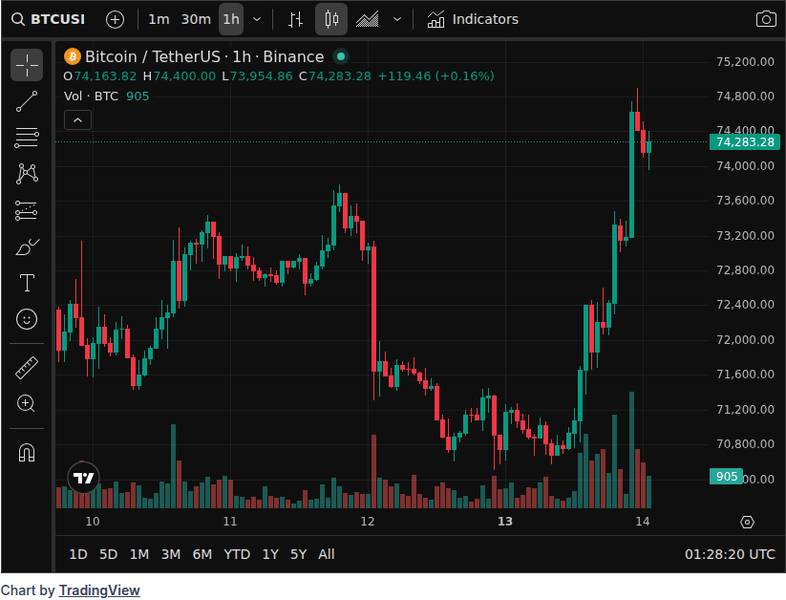 CoinGecko market data view included to frame the latest move in bitcoin.
Bitcoin’s price rose 4.56% over the prior 24 hours, but the broader sentiment environment remained cautious. The Fear and Greed Index registered at 21, classified as Extreme Fear.
What Must Happen for Finney’s Thesis to Become Plausible
Reaching $10 million per coin would require Bitcoin’s market cap to exceed $200 trillion, surpassing the combined value of global equities, bonds, and real estate. That demands a level of monetary adoption no single asset has ever achieved.
Adoption at Scale
Bitcoin would need to function not just as a store of value but as a primary unit of account and medium of exchange across nations, institutions, and everyday commerce. Current adoption, while growing, remains concentrated in trading and investment rather than payment settlement.
Trust and Infrastructure
Sovereign governments, central banks, and multinational corporations would need to accept Bitcoin as a settlement layer. That requires regulatory clarity, custodial infrastructure, and transaction throughput far beyond current capabilities, even with Layer 2 solutions like the Lightning Network.
The Assumptions Finney Acknowledged
Finney framed his post as a thought experiment, not a forecast. He explicitly used conditional language, writing “if Bitcoin becomes” rather than “when.” The $10 million figure was the output of a best-case scenario, not a baseline expectation.
That intellectual honesty is part of why the quote endures. It quantifies a maximum-case outcome using transparent math, giving the Bitcoin community a benchmark that is both aspirational and mathematically grounded, even if the preconditions remain far from met.
Disclaimer: The content of this article solely reflects the author's opinion and does not represent the platform in any capacity. This article is not intended to serve as a reference for making investment decisions.
You may also like
Jewett-Cameron (JCTC) First Quarter 2026 Earnings Call Transcript
American Express Shares: Two Key Factors Why This 175-Year-Old Titan Continues to Have Growth Potential

Short Squeeze Stocks: Bears Orbiting Satellite Names
Trending news
MoreCrypto prices
More





