
It's Tesla earnings night again, and the market is most concerned about these three things

Tesla is set to release its Q1 earnings after the US market closes on Wednesday (early Thursday morning Beijing time), but investors' focus goes far beyond the quarterly profits and losses themselves. Amidst the slow progress in Robotaxi expansion, an unclear mass production timeline for the Optimus robot, and the unveiling of a chip manufacturing plan with an "astronomical" scale, this financial report will serve as a critical point for the market to recalibrate the Tesla valuation narrative.
According to FactSet data, Wall Street expects Tesla’s Q1 adjusted EPS to be $0.37, up from $0.27 year-over-year; revenue is projected to be $22.2 billion, up roughly 15% from last year; EBITDA is anticipated to be $3.2 billion, an increase of around 17% year-over-year.
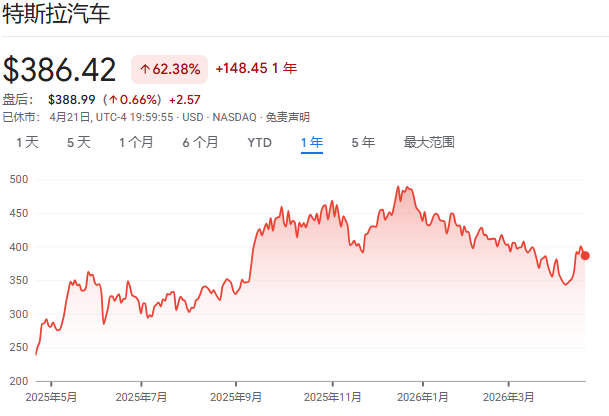
However, Tesla has already pre-disclosed that both electric vehicle sales and energy storage deployments were below market expectations, making the weak fundamentals largely anticipated by investors. Barclays analyst Dan Levy pointed out in a report that Tesla’s stock has fallen about 19% year-to-date, underperforming the S&P 500 by more than 20 percentage points, reflecting investor disappointment over the pace of Robotaxi expansion and the mass production outlook for Optimus.
For the market, the financial metrics themselves may not be the biggest variable. Jefferies analyst Philippe Houchois warned in a client report that this round of results “will further highlight the gap between vision and execution” and may raise concerns about financing issues; he also added that the results may “strengthen” the case for Tesla to eventually merge with SpaceX. Barclays maintains its “hold” rating on Tesla with a price target of $360. During the upcoming earnings call, management’s guidance on capital expenditures, Robotaxi expansion, and Optimus progress will be the core variables guiding the market’s reaction.
Capital Expenditures: Scale Debate, Unresolved Suspense
Heading into this earnings season, the central question is: Will Tesla raise its capex guidance, and will the financing path for massive projects such as Terafab become clearer?
In the previous quarter’s report, Tesla provided a 2026 capital expenditures guidance of over $20 billion to support six factory and production lines—including a lithium refinery, LFP battery plant, Cybercab, Semi truck, Houston super factory, and the Optimus line—as well as AI compute infrastructure expansion. Tesla plans to increase the effective number of Nvidia H100 GPUs from about 120,000 by the end of 2025 to about 280,000 by the end of June. Barclays estimates that the GPU procurement alone will cost more than $3.5 billion, with another $2.5 to $3 billion needed for supporting infrastructure.
However, the above-mentioned $20 billion guidance explicitly excludes the Terafab chip plant and the solar factory projects. In March, Tesla announced the Terafab initiative, aiming to build a chip manufacturing facility with an annual output of 1 terawatt of computing power—about 50 times the world’s current total AI compute output—with SpaceX, Intel, and Super Micro Computer all involved.
If Terafab is fully implemented, the total capital expenditure could reach $5 trillion to $13 trillion; even focusing on the near- and medium-term ground chip production with an initial target capacity of 100–200 GW/year could require $500 billion to $1 trillion in investments. Barclays believes that Terafab currently lacks a concrete construction timeline and financing plan, making it a “story to be verified.”
On the solar side, Tesla plans to build 100 GW of manufacturing capacity in the US by 2028. Reports indicate that Tesla has been negotiating with Chinese suppliers for $2.9 billion worth of solar production equipment, scheduled for delivery before August this year. Barclays estimates the capital expenditure for this project will be at least $30 billion.
Morgan Stanley analyst Andrew Percoco expects Tesla’s annual capital expenditures to rise to $25–35 billion and estimates that under a $21 billion capex scenario, free cash flow in 2026 will be negative $8.4 billion; FactSet data shows consensus expectations for negative free cash flow exceeding $4.7 billion.
On this point, GraniteShares CEO Will Rhind told MarketWatch, “Even if 2026 free cash flow expectations keep being lowered, Tesla still has the strongest net cash position and the most flexibility in its balance sheet in the industry—enough to bet on all these directions at once. That’s what underpins its valuation premium.” However, Barclays expects large-scale expenditures to keep Tesla’s free cash flow negative, possibly extending to 2029.
Robotaxi: Expansion Accelerates, but Scale Remains in Question
The progress of Robotaxi's scaling is currently the core story driving Tesla’s valuation, and one of the most closely watched topics in this financial report.
Over the weekend, Tesla announced Robotaxi service expansion to parts of Dallas and Houston—previously, the service only covered Austin, Texas and the Bay Area in California. This marks Tesla’s first substantial geographic expansion since the limited unsupervised service launched in Austin in January of this year. Tesla also plans to extend its service to at least nine cities by the end of June, including Las Vegas and three cities in Florida.
However, the limited scale of expansion compared to investor expectations has led to noticeable dissatisfaction. Crowdsourced tracking data shows only four vehicles operating in Dallas and Houston combined. Last July, Tesla CEO Elon Musk claimed that half of the US population would have Robotaxi service by the end of 2025, but that target is clearly unmet. On the Tesla investor platform, a shareholder with 275,000 shares directly asked: “Why is the rollout of the Robotaxi network so slow?” Another shareholder questioned: “Why is progress behind less than 90 days after the last guidance?”
UBS analyst Joseph Spak said in a note earlier this month that he doesn’t expect to see “meaningful scaling” in Tesla’s target cities, maintaining a neutral rating and a $352 price target. He wrote, “We believe the technology keeps improving, and the infrastructure will gradually be put in place, but given the importance of the safety culture, Tesla’s rollout will move cautiously.” Morgan Stanley points out that the accelerated rollout of Robotaxi service is “crucial” to supporting Tesla’s high valuation.
Optimus: Awaiting Deliverables, Validation Needed
Alongside Robotaxi, the Optimus robot is another core growth narrative for Tesla, but both remain “more showcase than implementation” for now, and management remarks on the earnings call will be critical.
According to Say Technologies data, the most concerned question among shareholders on the investor platform is the timeline for Optimus. One investor, holding 2.2 million shares, asked: “When will Optimus V3 be released? Since the Model X and S lines are stopping production by midyear, when will Optimus mass production begin?” Musk previously stated that Optimus V3 would debut in March, but only a short promotional video was shown and an official release delayed to address issues.
In January, he stated that Optimus will be available to the public by the end of 2027, with mass production starting later this year on some lines formerly used for EV manufacturing. Morningstar analyst Seth Goldstein told MarketWatch: “By 2028, as Tesla starts generating revenue from Robotaxi and robotics, we should really start to see this transition reflected in the financials.”
Barclays remains cautious, incorporating only limited ten-year Optimus sales forecasts in its model. However, Barclays also acknowledges that any specific progress updates for the aforementioned projects would be a positive catalyst for the stock price.
Fundamentals: Weakness Priced In, Downside Risks Remain
Beyond the three major themes, the fundamentals of Tesla’s core auto business continue to face pressure, though this has been largely anticipated by the market.
Barclays expects Tesla’s Q1 automotive gross margin (excluding regulatory credits and including equity incentives) to be about 14.4%, down about 350 basis points quarter-on-quarter, mainly dragged by a decrease in deliveries by about 60,000 units (down around 14%), and rising costs of raw materials such as steel, aluminum, copper, and precious metals. Offsetting factors include tariff refund income—Tesla’s 100% US-made characteristic may entitle it to IEEPA tariff refunds—along with stable pricing and improved regional sales mix.
For regulatory credits, Barclays expects Q1 revenue to be about $300 million, lower than $542 million last quarter and $595 million in the same period last year. For energy storage, Q1 deployments were 8.8 GWh, well below the market expectation of 14.4 GWh, and Barclays expects this business’s gross margin to drop from about 29% to around 25% compared to last quarter.
On a yearly basis, Barclays projects Tesla will deliver about 1.61 million vehicles in 2026, less than 1.64 million in 2025 and below the market consensus of around 1.67 million; full-year EPS is forecasted at $1.57, below the consensus of $1.94. It’s worth noting that market consensus has fallen sharply from $3.82 a year ago, but Dan Levy believes there is still room for downward revision. Over the last 12 months, Tesla’s stock price has swung widely between $229.85 and $498.83, closing Tuesday at about $386, down 1.6%.
Disclaimer: The content of this article solely reflects the author's opinion and does not represent the platform in any capacity. This article is not intended to serve as a reference for making investment decisions.
You may also like
UMXM (Manadia) surges 15,350% in 24 hours: Driven by Kraken and Bitget listing announcements
USD: Energy shock view anchors DXY range – BBH
VELVET fluctuated 49.2% in 24 hours: trading volume surged alongside price rebound

Trending news
MoreCrypto prices
More





