AI agents and trading bots run on data. An agent needs prices, wallet context, signals, and execution rails. Almost all of that arrives through APIs. The wrong choice slows shipping and inflates running costs.
This guide covers ten crypto APIs suited to automated systems. It builds on our broader guide to crypto API providers for builders. That article ranked general-purpose providers. This one focuses on agent and bot workloads specifically.
The list spans five layers. Aggregated data, swap execution, trading signals, sentiment, and node infrastructure each appear. No single provider covers everything. Most production bots end up combining two or three.
What AI Agents and Trading Bots Need From a Crypto API
MCP support. Model Context Protocol turns API endpoints into callable tools for LLMs. An agent queries data in natural language. Providers with native MCP servers remove adapter code entirely.

Structured portfolio context. Bots act on positions, not only prices. Wallet balances, PnL, and DeFi exposure matter as inputs.
Ready-made signals. Pre-computed indicators save months of pipeline work. Sentiment and on-chain metrics add context beyond candles.
Execution rails. Many bots must convert assets, not only read data. Swap APIs handle conversion without exchange accounts.
Predictable pricing. Bots poll constantly. Credit models, rate limits, and free tiers decide real operating costs.
With those criteria in mind, here are the ten providers.
1. CoinStats API
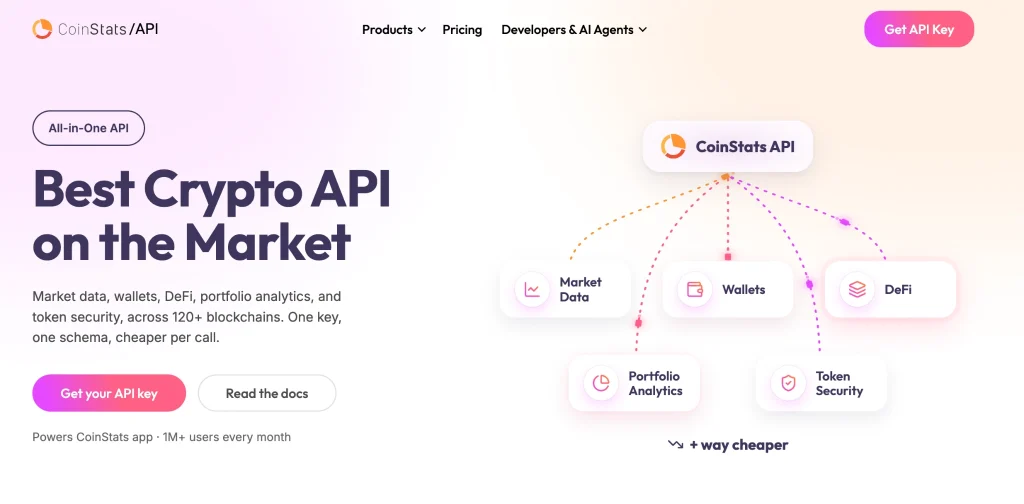
CoinStats’ crypto API is the broadest data layer on this list. One key returns market data, wallet balances, DeFi positions, portfolio analytics, and token security. For agent builders, the draw is CoinStats MCP Server. It exposes every data category as callable tools for LLMs. Agents in Claude Code, Cursor, and VS Code query it directly.
Coverage runs deep. The API tracks 100,000+ coins across 200+ exchanges. Wallet and DeFi data spans 120+ blockchains. DeFi positions are auto-detected across 10,000+ protocols. Supported networks include Solana, Ethereum, EVM chains, and Bitcoin. Bitcoin wallets work with xpub, ypub, and zpub keys. Historical pricing reaches back ten years. A news feed aggregates 200+ sources.
Trading bots gain a safety layer too. A Token Security endpoint screens EVM contracts before a trade. It runs on Hexens’ Glider security engine. Flags cover honeypots, hidden fees, and upgradeable proxies. The same checks protect 1M monthly CoinStats users. That production base gives the API a track record at scale.
Pricing is credit-based with a free tier at signup. Credits scale with endpoint complexity. A full endpoint and credit breakdown sits in this crypto API guide.
Where it fits: Most agent and bot data needs. AI trading assistants, portfolio-aware bots, multi-chain monitors, and market aggregators all fit.
Limitations: No raw blockchain RPC or node-level access. Not built for microsecond-scale high-frequency trading.
2. ChangeHero
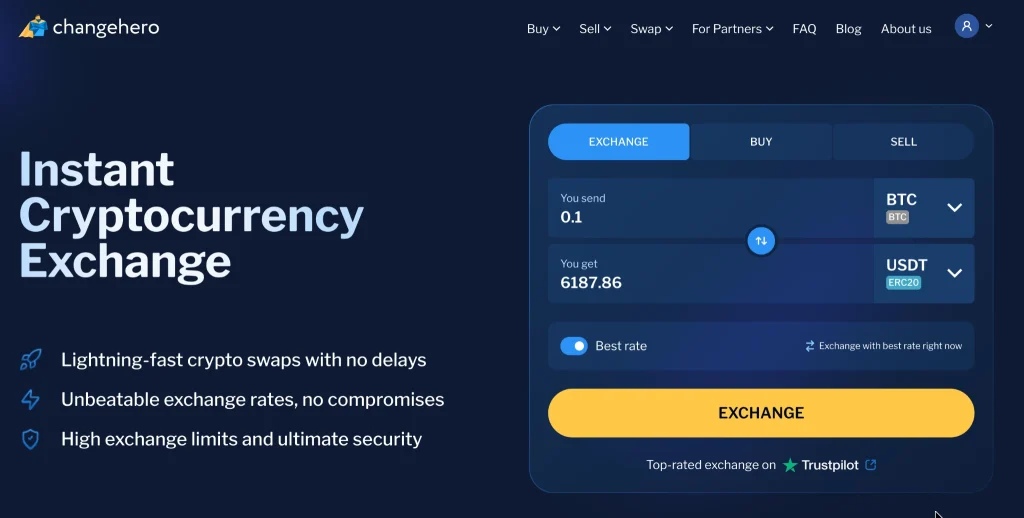
ChangeHero is a non-custodial swap API with a long partner record. The platform has run since 2017. Hardware and software wallets integrate its swap engine. Partners include Trezor, Exodus, Tangem, and OneKey.
The API covers 350+ cryptocurrencies. Fixed and floating rates run through dedicated endpoints. Liquidity aggregates from multiple trading venues. If one source drops, swaps can continue uninterrupted. Settlement typically lands under 10 minutes.
For automated systems, ChangeHero handles the conversion step. A rebalancing bot can rotate holdings without exchange accounts. Treasury scripts can convert revenue on a schedule.
Custom setups, developed by request, support features like optimized routing and zero-fee stablecoin pairs.
Integration is free. Partners earn a configurable commission per swap. There are no volume minimums.
Where it fits: Swap automation, rebalancing systems, wallet integrations, and treasury conversion flows.
Limitations: Not a market data provider. Pricing feeds and portfolio context need a separate source.
3. StealthEX
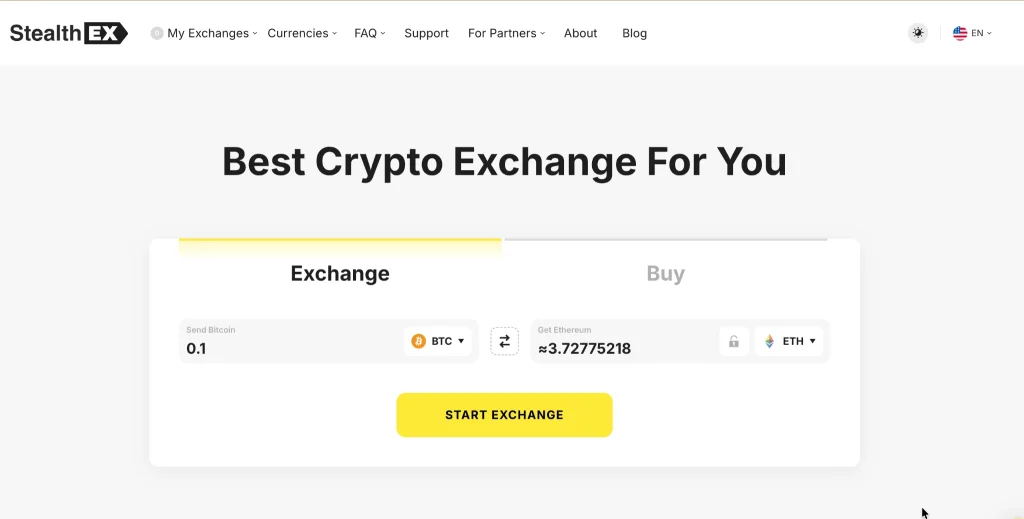
StealthEX is a privacy-focused instant exchange API. It is fully non-custodial. End users never create StealthEX accounts. Standard swap volumes require no mandatory KYC. Risk-based screening applies only to flagged transactions.
Coverage spans 2,000+ coins and tokens across many networks. The REST API supports fixed and floating rates. Floating rates match market price at execution. Fixed rates lock the receive amount in advance. Settlement usually takes 5 to 30 minutes.
The commercial model suits bot builders. Integration is free with no monthly commitments. Partners set a commission between 0 and 0.5 percent. Revenue share applies to routed volume. The team also publishes a free crypto API comparison for budgeting.
Where it fits: Telegram bots, wallets, DEX aggregators, and privacy-minded conversion flows.
Limitations: No market data or analytics endpoints. Settlement runs in minutes, not milliseconds.
4. ChangeNOW
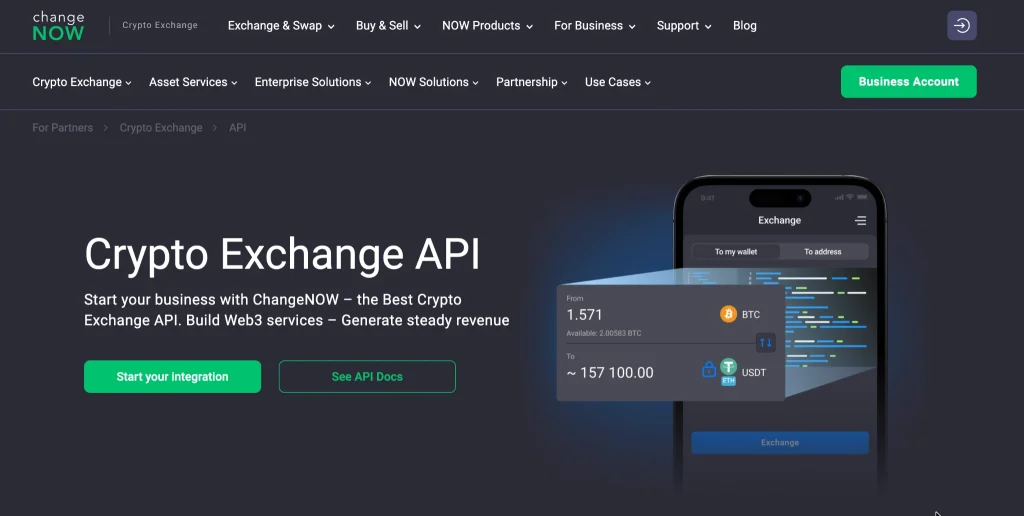
ChangeNOW is swap infrastructure built for scale. The API covers 1,500+ assets across 110+ networks. More than two million exchange pairs are available. Liquidity aggregates from both CEX and DEX venues. Swaps typically settle in under one minute.
Compliance posture is a differentiator here. ChangeNOW holds SOC 2 Type II and ISO 27001:2022 certifications. A 99.99 percent uptime SLA backs the service. Integration options include a full API, a widget, and white-label.
The pricing model is volume-based. There are no setup or monthly fees. Partners share revenue on each transaction.
Where it fits: Bots needing fast conversion, payment flows, wallets, and embedded swap apps.
Limitations: Not a data provider. Minimum swap amounts apply, typically $1.70 to $20. UK users are not supported.
5. altFINS Analytics Data API
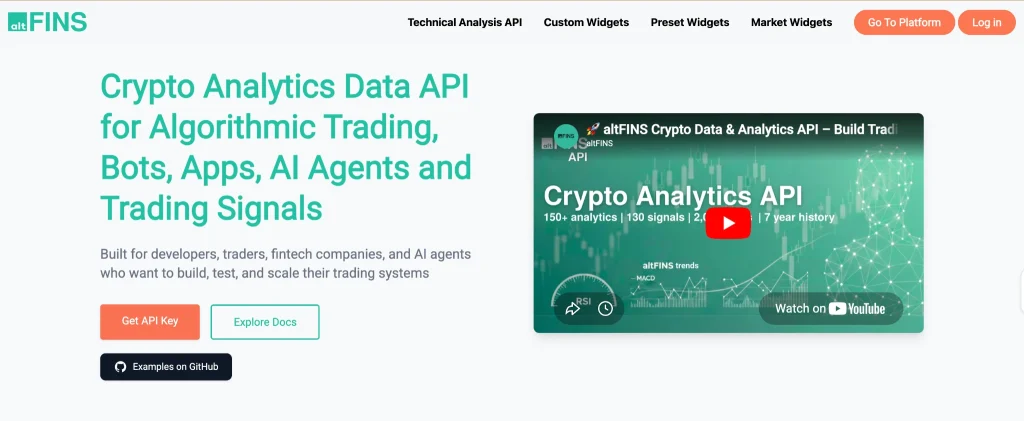
altFINS Analytics Data API delivers pre-computed trading analytics. The feed includes 150+ technical indicators and 130+ ready signals. Coverage spans 2,000+ assets across 30 exchanges. Five intervals run from 15 minutes to one day. Historical depth reaches 7+ years for backtesting.
Signals arrive ready to consume. Breakouts, momentum shifts, and crossover events need no custom logic. Fundamental metrics add TVL and protocol revenue context. An MCP Server adapts the feed for LLM queries. AI trading copilots consume signals without extra middleware.
Pricing starts free with 1,000 monthly credits. Paid plans begin at $39 per month.
Where it fits: Algorithmic trading bots, AI copilots, quant backtesting, and signal-driven platforms.
Limitations: Asset coverage is narrower than broad-market aggregators. No wallet tracking or on-chain analytics.
6. CEX.IO API
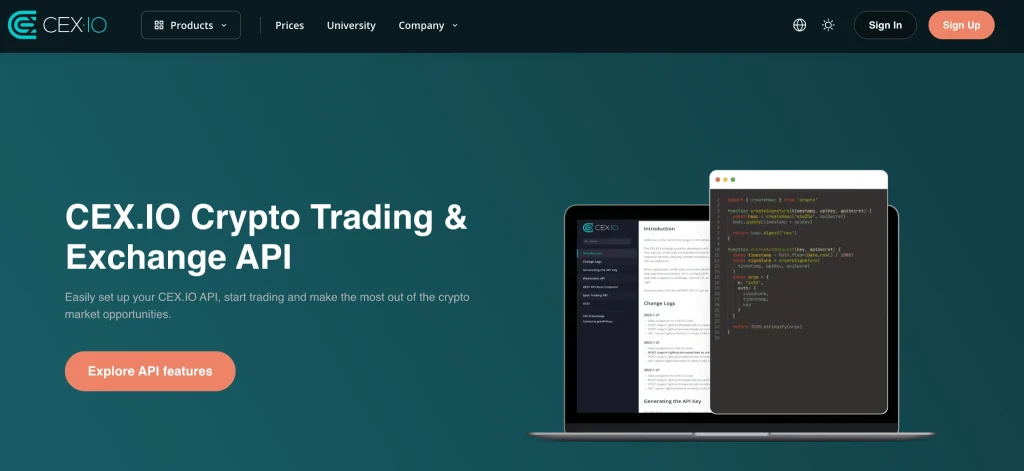
CEX.IO API is a centralized exchange API for traders. It serves teams building bots, arbitrage strategies, and execution tools. Transport covers REST and WebSocket, with FIX available for institutions. REST handles order management cleanly, while WebSocket suits real-time data. WebSocket delivers around three times more information per request than REST.
Endpoints expose order book, market depth, trade history, and OHLCV. Developers can stream real-time data and pull historical market data. A sandbox environment allows bot testing before going live. That feature is missing from many retail-focused exchanges.
API access is free with a CEX.IO account. For a broader look at crypto data APIs, see CEX.IO’s provider crypto api guide.
Where it fits: Algorithmic traders and bots running on CEX.IO’s order book.
Limitations: Scope is a single exchange. Market coverage and on-chain data need separate sources.
7. GetBlock
GetBlock covers the node infrastructure layer. The platform provides RPC access to 130+ blockchains. Interfaces include JSON-RPC, REST, GraphQL, WebSocket, and gRPC on select networks. Shared nodes suit prototypes and smaller bots. Dedicated nodes target high-throughput and latency-sensitive workloads.
On-chain bots need this layer for direct chain access. Mempool reads, contract calls, and transaction broadcasting all run here. Geo-distributed clusters run in Frankfurt, New York, and Singapore. Independent benchmarks rank its Solana RPC fastest in Europe at 6 ms.
Pricing stays predictable for bot workloads. Every call deducts one request regardless of method complexity. The free tier allows 50,000 requests per day. Paid plans add throughput, dedicated nodes, and SLA guarantees. A dedicated MCP server connects the RPC layer to AI agents.
GetBlock returns raw chain data rather than parsed portfolios. Most teams pair it with a data API upstream. Read more on this api guide.
Where it fits: On-chain trading bots, mempool monitors, multi-chain dApps, and custom indexers.
Limitations: No aggregated market data or wallet analytics. Enriched data needs a separate provider.
8. LunarCrush
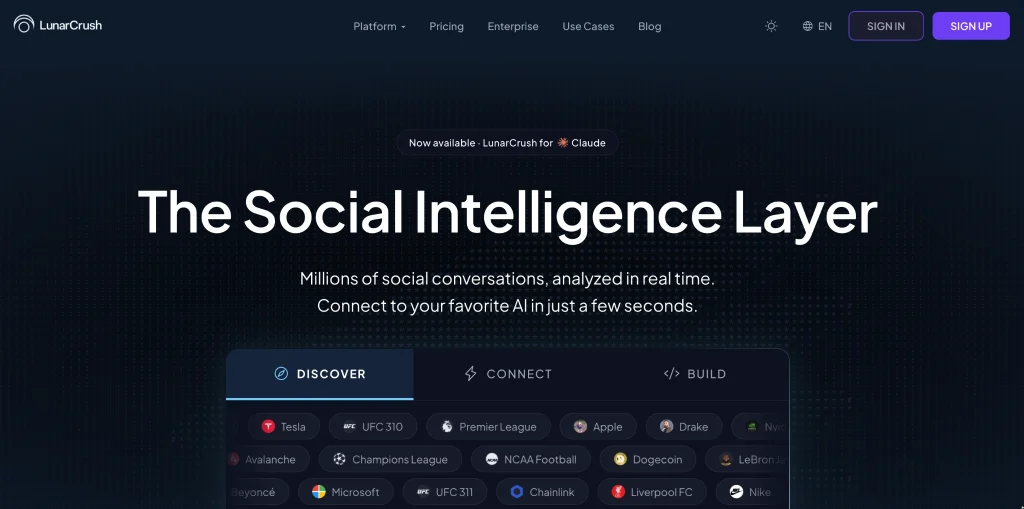
LunarCrush measures the social side of crypto markets. The platform ingests posts from X, YouTube, Reddit, and TikTok. Machine-learning models score sentiment on crypto-specific language. Proprietary metrics include Galaxy Score and AltRank. Interactions, social dominance, and creator data round out the feed.
Sentiment is a natural input for trading agents. A bot can pair sentiment shifts with price action. Narrative changes surface before they appear in candles. An official MCP server connects the data to LLM agents. REST endpoints return simple JSON for everything else.
API access runs on subscription plans. Plans gate call volume and historical depth.
Where it fits: Sentiment-driven bots, narrative scanners, AI research agents, and social ing.
Limitations: Not a price or portfolio provider on its own. Best paired with market and wallet data.
9. Santiment
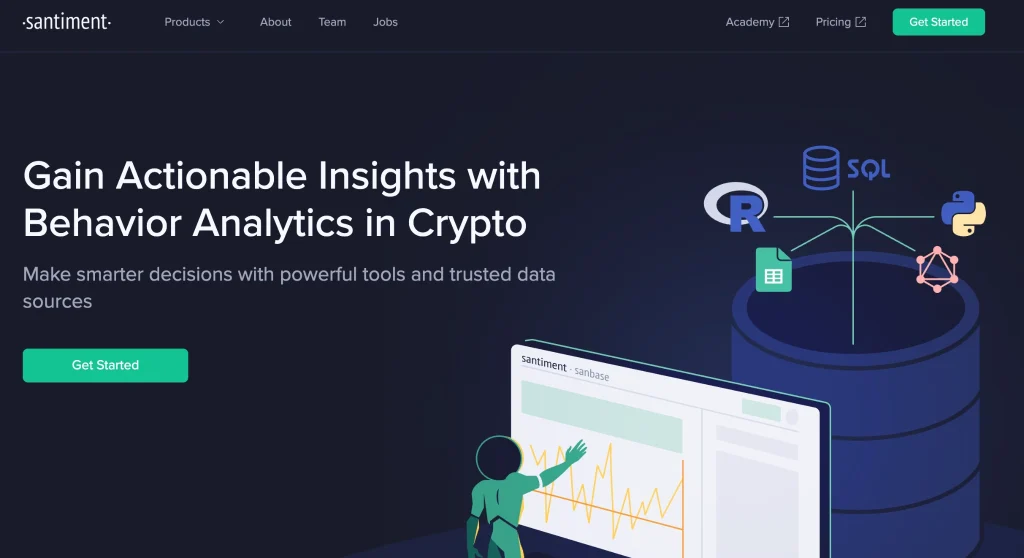
Santiment blends on-chain, social, and developer metrics. SanAPI exposes the data through GraphQL exclusively. Coverage spans 3,000+ assets, with metrics varying by chain. On-chain data comes from Santiment’s own nodes. Exchange flows, whale transactions, and network activity are core feeds.
The platform suits behavior-based strategies. A bot can track exchange inflows as sell-pressure proxies. Social volume spikes pair with on-chain confirmation. A Python client, sanpy, returns pandas DataFrames for backtesting. An MCP connector serves AI agent workflows.
A free tier exists with a 30-day lag on restricted metrics. Paid plans unlock real-time access.
Where it fits: Quant research, behavior-driven bots, ing systems, and AI analysis agents.
Limitations: GraphQL adds a learning curve for REST-first teams. Chain coverage is narrower than broad aggregators.
10. CCXT
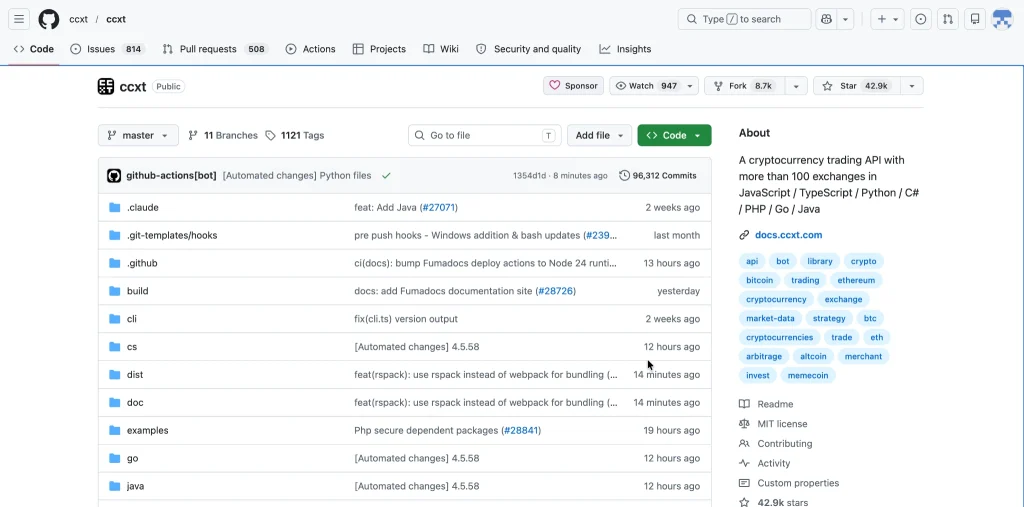
CCXT is the open-source standard for exchange connectivity. It is a library, not a hosted API. One unified interface covers 100+ centralized exchanges. Market data and order placement share consistent methods. Languages include JavaScript, Python, PHP, C#, and Go.
Most trading bots touch CCXT somewhere in the stack. It handles authenticated trading against exchange accounts. Order books, balances, and trade history follow one schema. The MIT license allows free commercial use.
The tradeoff is operational. You manage API keys, rate limits, and infrastructure yourself. There is no SLA or hosted support.
Where it fits: Exchange trading bots, arbitrage systems, backtesting rigs, and custom terminals.
Limitations: No data aggregation or normalization service behind it. Reliability depends on each exchange and your own setup.
Comparison Table
| Provider | Category | Free tier | Paid entry | MCP |
| CoinStats API | Market, wallet, and DeFi data | Free credits at signup | Credit-based tiers | Native MCP Server |
| ChangeHero | Swap infrastructure | Free integration | Commission per swap | No |
| StealthEX | Swap infrastructure | Free integration | Revenue share | No |
| ChangeNOW | Swap infrastructure | Free integration | Revenue share | No |
| altFINS | Trading signals and indicators | 1K credits/month | $39/month | Yes |
| CEX.IO API | Exchange trading API | Free with account | Free (trading fees apply) | No |
| GetBlock | RPC node infrastructure | 40K requests/day | Pay-per-use or subscription | Yes (dedicated server) |
| LunarCrush | Social sentiment | Limited | Subscription | Yes |
| Santiment | On-chain and social analytics | Free, 30-day lag | Subscription | Yes (connector) |
| CCXT | Exchange connectivity, open source | Free (MIT) | Free | No |
How to Choose
Start from the job, not the brand.
For the data layer, CoinStats API covers the widest surface. Market data, wallets, DeFi, and MCP sit behind one key. Most agent builds can start there. For signals, altFINS ships indicators ready to trade. LunarCrush and Santiment add sentiment and behavioral depth.
Execution is a separate decision. ChangeHero, StealthEX, and ChangeNOW each provide swap rails. CEX.IO API and CCXT cover direct exchange trading instead. GetBlock supplies the node layer underneath on-chain bots.
Most production systems combine layers. A common stack pairs one data API with one execution rail. Add infrastructure or sentiment only when the strategy demands it. The right combination depends on what the bot actually does.