

Indonesia is poised to allow a significant rise in nickel mine production later this year, providing relief for local smelters while weighing on global prices of the battery metal.
The Energy and Mineral Resources Ministry has informed some miners that mid-year revisions will boost total mining quotas, known locally as RKABs, to 360 million tons for this year, according to people familiar with the matter, who asked not to be identified because the information is private. That’s up from about 260 million tons issued in the first half.
The plan to relax quotas may yet change and remains at the discretion of Energy Minister Bahlil Lahadalia, the people said. Miners are set to apply for increases in their RKABs at the start of next month. A spokesperson for the ministry said the size of the revision had not yet been finalized.
If approved, the move would mark a sharp reversal from Indonesia’s tightening of nickel quotas at the start of the year, which triggered a major rise in prices on the London Metal Exchange. Since banning exports of raw ore in 2020, Indonesia’s share of global production has surged to about 60%, driven by tens of billions of dollars of investment by Chinese smelting firms.
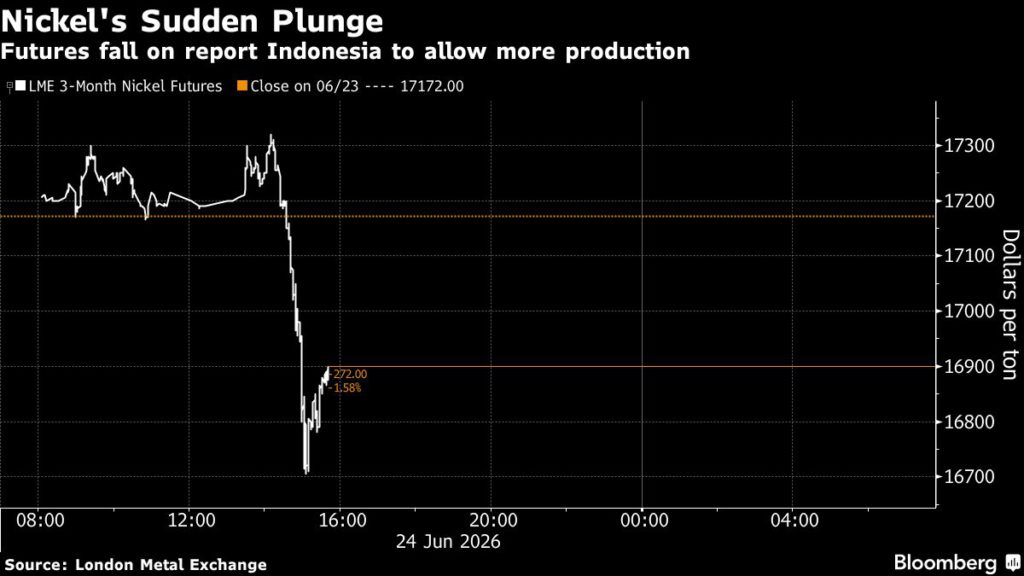
Benchmark nickel futures flipped to losses on Wednesday, dropping as much as 2.7% to $16,705 a ton on the London Metal Exchange, before trading at $16,860 at 12:21 p.m. in London.
Miners such as PT Weda Bay Nickel, formerly the world’s largest nickel ore producer, were forced to suspend output last month after exhausting its drastically lower quota. Others, including PT Vale Indonesia, require significant increases to supply new processing plants that are set to come online.
While Indonesia’s nickel quota issuance provides a broad guide for the country’s annual output, it does not directly tally with it. All miners, including those at the exploration stage that are not yet producing, are required by the ministry to obtain RKABs.
Miners that have obtained bigger quotas may also struggle to meet them due to the time taken to ramp up production. Operations in Indonesia are also frequently hampered by weather conditions such as heavy rain.
(By Eddie Spence and Faris Mokhtar)


