
web3: Bitcoin BIP-110 fork chain halted after only two blocks

A minority of nodes supporting Bitcoin Improvement Proposal BIP-110 split from the main chain at block height 961,632, but this new chain quickly stagnated after going live. In about 8 hours, it produced only 2 blocks, while in the same period, the Bitcoin main chain proceeded with 48 blocks.
The forked chain is clearly lagging behind the main chain
According to monitoring data, the forked chain stalled at block 961,633, while the main chain has already reached 961,681. The Bitcoin network usually generates a new block approximately every 10 minutes. This current gap shows that the main chain remains operational, whereas the forked chain has practically lost its ability to produce blocks.
The goal of BIP-110 is to restrict the inclusion of non-financial data such as images and text in Bitcoin transactions within a year. Supporters argue that these types of data occupy block space and drive up the costs of ordinary transfers; opponents, however, contend that as long as fees are paid, users deserve the right to use block space and that miners and nodes should not decide which transactions are “legitimate uses.”
Miner support rate far below the threshold
After the fork occurred, nodes running BIP-110 software would reject all blocks that did not signal support for the proposal. The first block without a support signal was mined by AntPool, and it was accepted by the mainnet; meanwhile, miners using Ocean produced an alternative block following the forked chain.
However, in the past two weeks, only 2.53% of blocks signaled support for BIP-110, which is far below the 55% threshold required for activation without a fork. The lack of miner support means this chain will struggle to maintain consistent block production and stands almost no chance of meeting the signaling requirement within the designated window.
Transacting forked coins carries additional risk
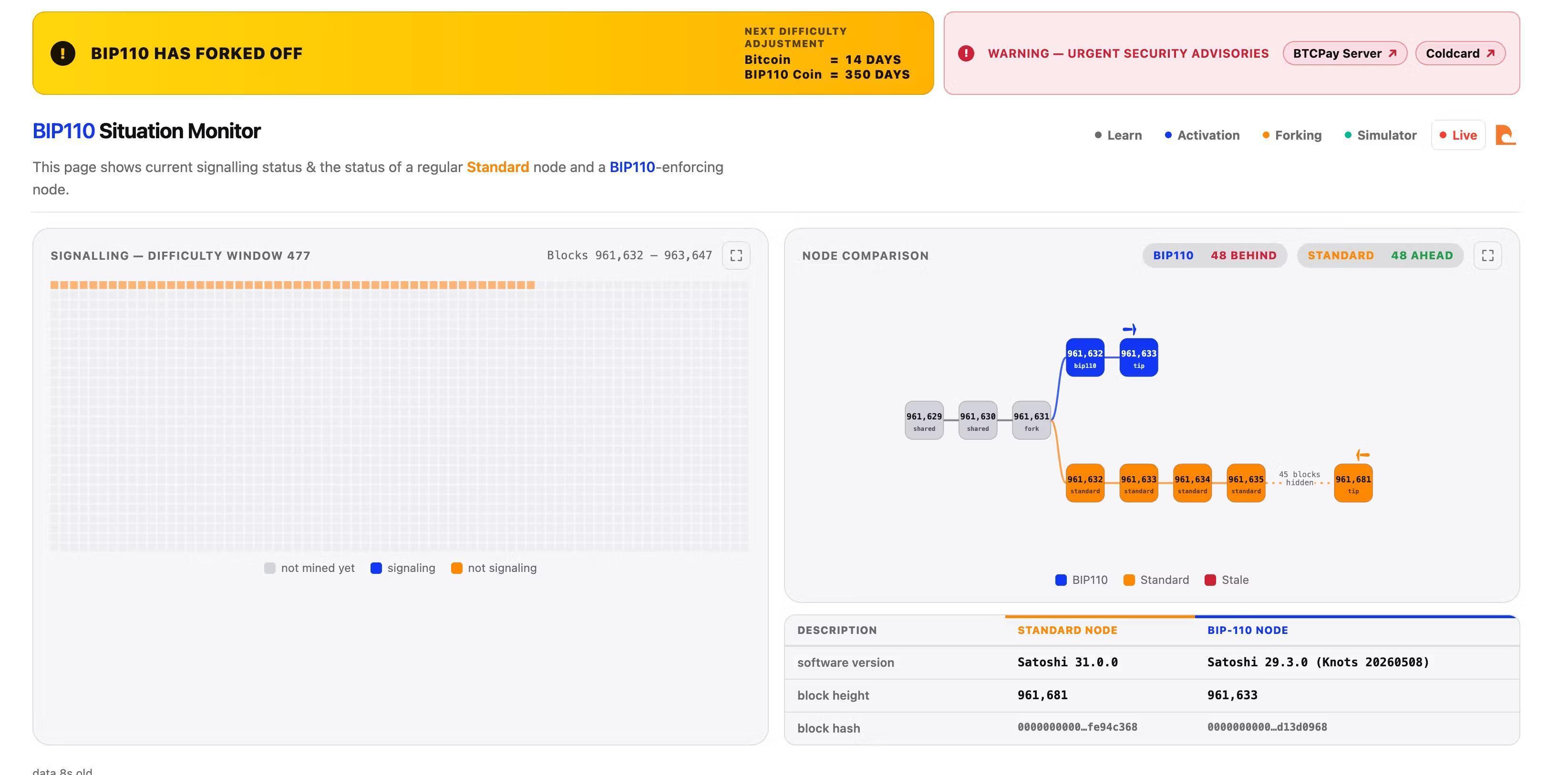
The report mentions that both chains currently still accept transactions with the same format. If users sign to send tokens on the forked chain, the transaction could also be rebroadcast on the Bitcoin main chain, causing sellers to unknowingly transfer real BTC as well, resulting in a replay-like risk.
Meanwhile, with the forked chain producing a block only every few hours, transaction confirmation is very slow. Even if someone tries to sell forked coins, both execution and settlement would be significantly impacted.

The two-week window for BIP-110 nodes to require continuous signaling for support will continue until block 963,647. At the current block production rate, the forked chain is still very far from that goal.
Disclaimer: The content of this article solely reflects the author's opinion and does not represent the platform in any capacity. This article is not intended to serve as a reference for making investment decisions.
You may also like
TUT surpasses $0.2, with an intraday increase of over 370%
Analyst to XRP Holders: We’ve Reached the Most Important Level. Here’s What It Means
PUMP surges 106% from June lows amid bullish reversal – $0.0046 target in play
web3: Weekly inflow for XRP ETF drops to $1.01 million
Crypto prices
More


