
Morgan Stanley Bets on Three Types of Investments!


👆Click the blue text to follow us
Morgan Stanley Favors 3 Major Investments
Do you still remember Morgan Stanley’s cycle rotation report from last week? At the time, Morgan Stanley strategist Michael Wilson stated that the US stock market has switched from an early cycle to a mid-cycle phase, and market leadership is shifting from low quality, high beta assets to high quality, sustainable assets. Now a week has passed, earnings updates have come in, and the market has seen significant changes. So, has Wilson’s assessment shifted? What big risks will US stocks face next? Let’s take a look at Morgan Stanley’s latest weekly preview report.
In the latest report, Wilson believes that this round of earnings has further confirmed two things: First, US corporate profits are spreading from a handful of tech giants to a broader base of companies; second, while the market is willing to reward earnings growth, it has become considerably more demanding about the quality of those earnings. Therefore, Wilson’s judgment remains unchanged, and based on price action, his previous assessment has been correct.
First, let’s look at the earnings diffusion. The report notes that the Russell 3000 index, which represents a broad swath of US companies, saw a median YoY revenue increase of 8%, the strongest level since 2023; median EPS grew by 15%, the highest since 2021. In S&P 500 companies that have reported earnings, 87% surpassed EPS estimates, up from 82% last quarter. Meanwhile, positive earnings estimate revisions for the S&P 500 have rebounded to 23%, and 76% of industries saw positive revisions. Both the breadth of upward revisions and range of beneficiaries are near their cycle highs.
These indicators prove the earnings diffusion and simultaneously address the market's concern that this round of earnings growth is no longer fully reliant on the “Magnificent Seven.” Increasingly, ordinary companies are recovering. As the breadth of earnings growth continues, index reliance on megacap companies decreases, and the overall resilience of US equities increases.
However, earnings diffusion does not mean all stocks will rally together. Wilson believes that as the business and earnings cycles mature, simple profit rebounds driven by low bases, cost-cutting, and operating leverage gradually lose their appeal. The market will focus next on the sustainability of profits, stability of margins, and levels of free cash flow.
This quarter, S&P 500 companies with both upward EPS and free cash flow revisions saw a median outperformance of 1.6% post-earnings. However, if only EPS was revised up but free cash flow was revised down, stock prices actually trailed by 0.2%. Market pricing is clearly reflecting demands for sustainable earnings and free cash flow.
This reveals the most obvious contradiction this earnings season. This quarter, companies reporting have largely beaten expectations—a truly strong showing on paper. Yet the overall day-one stock price response to earnings has been underwhelming.
Wilson believes this is because, prior to results, markets had already revised up earnings estimates by approximately 2% for the quarter. Historically, Q2 is usually a weak season where expectations are revised down about 5%, so the hurdle for companies this time was already higher. Another factor: Index-level earnings growth was magnified by AI investment gains among some Big Tech companies. Once these investment gains flowed into profits, they inflated earnings beats—but these gains are not the main business and their sustainability is questionable.
Thus, the 44% year-on-year earnings growth for the index this season cannot all be valued as sustainable growth. The 15% median EPS growth in the Russell 3000 is a better illustration of the fundamental strength of American companies. But even at 15%, current US corporate profits are in good shape; it’s just that the market is attaching different price tags to different qualities of earnings.
That concludes the first section—based on this round of earnings and price action, Morgan Stanley confirms two things: First, both profits and free cash flow need to rise together to constitute high quality; the market is more willing to reward such companies sustainably. Second, this quarter’s outsized investment gains inflated the median, but even when excluded, the underlying median remains strong, suggesting a solid US equity structure with broader small and mid-cap participation. Next, let’s examine the internal divergence among tech stocks.
Morgan Stanley expects the “Magnificent Seven” to achieve a 56% net income increase between now and 2026, which remains very strong for this year. But by 2027, because of this year’s high growth and some non-operating gains lifting the base, next year’s year-on-year numbers will naturally be pressured. As a result, earnings growth could slow to 4% for these giants. However, due to their high-quality cash flow, Morgan Stanley believes valuations should remain intact.
Therefore, Morgan Stanley continues to prefer large-scale cloud computing companies, prioritizing them over semiconductors. Semiconductors may see a tactical rebound after the recent momentum pullback, but large cloud platforms have more stable core businesses, AI investment returns have not been fully priced in, and they can also use AI internally to improve efficiency. Thus, considering the risk-reward over the coming months, large cloud platform companies are a better fit for Morgan Stanley’s quality framework.
Here's one more point: last Friday I shared that semiconductors relative to software have reached historic extremes, and a mean reversion is likely in the short term. Thus, my view is that after the CPI report tomorrow, if the data meets or even beats expectations, within two to three weeks, investors could consider going long semiconductor ETF SMH while shorting software ETF IGV to catch the short-term correction of the two. However, if the CPI unexpectedly heats up, this long/short pair trade should be put on hold for now.
Continuing with the research report, Morgan Stanley’s second favored direction is large financial services companies, especially those focused on insurance and capital markets. Earnings estimates for financials and breadth of upward revisions are also rising. Historically, these changes usually improve relative performance, and Morgan Stanley’s cycle model supports continued outperformance for large financial institutions.
The third direction is consumer discretionary goods. The focus here is on goods, including durables and apparel, not services. Morgan Stanley believes the core is that pricing for goods is improving, and the breadth of earnings upward revisions in relevant sectors is rebounding. If fundamentals continue to deliver, discretionary goods have a chance to make up for previous underperformance.
Finally, the risks. Wilson believes that the main risks now are still long-end US Treasury yields and oil prices. Morgan Stanley thinks rising Treasury yields are not necessarily a negative for equities: If yields rise together with manufacturing PMI and nominal GDP, stocks have historically performed quite well.
However, if long-term Treasury yields rise rapidly due to inflation expectations, real rates, or term premia, both corporate capital costs and stock valuations will come under pressure. If oil prices surge, inflation could reaccelerate, squeezing consumer purchasing power and limiting the Fed’s policy space. At that point, quality rotation within the mid-cycle may still hold, but the entire index will face stress.
This is also reflected in Morgan Stanley’s index targets. At the time of the report, the S&P 500 was around 7,758 points. Morgan Stanley’s base case target is 8,300 points, a roughly 7% upside, corresponding to a year-end S&P EPS of $339, lower than the market consensus of $359. So Michael Wilson recognizes the continued earnings cycle, but given the risks, does not provide an aggressive rally or profit outlook at the index level.
That's basically the end of the research report—Wilson offers a comprehensive view, and I agree with the idea of cycle rotation: US stocks are shifting from low quality, high beta to high quality, sustainable direction, and the quality factor is also where our US investment tracking system focuses. We are also quite optimistic.
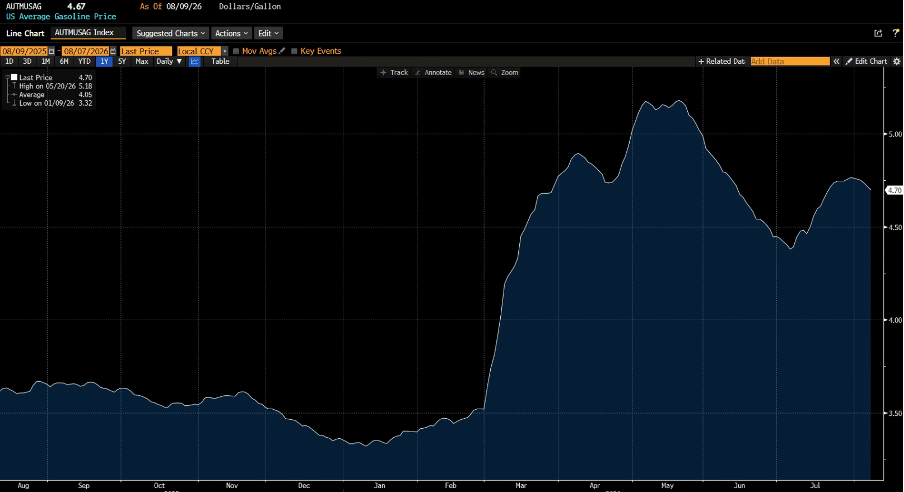
Next, the market’s main focus remains on the war, oil prices, and inflation. In July, oil prices did not drop significantly; according to Bloomberg data, after a sharp decline in average US oil prices from late May to early July, they rebounded quickly, by roughly 9%. So the backdrop isn’t great, but if core CPI remains on a cooling path, this should ease rate hike expectations and strengthen the Fed’s confidence in holding steady.



Disclaimer: The content of this article solely reflects the author's opinion and does not represent the platform in any capacity. This article is not intended to serve as a reference for making investment decisions.
You may also like
Trend funds are heavily betting on persistent inflation, with record short positions in bonds awaiting tonight's CPI "verdict"!
Epic short positions in U.S. Treasury bonds await the "judgment" of the CPI: 1.29 million net short contracts bet on persistent inflation. UBS warns that the $300 million per basis point risk exposure is the highest in 30 years.

From Luxury to Cheap Symbols: The Diamond Market Is Accelerating Its Collapse
The Bloomberg Diamond Standard Index has fallen to a record low, with natural diamond prices down about 50% over the past four years. Even a 20% reduction in production has failed to curb the downward trend. As inheritance from the baby boomer generation floods the second-hand market, supply pressure is expected to intensify. Analysts warn that diamonds may repeat the fate of natural pearls a century ago, tumbling from a symbol of wealth to being seen as "tacky." For the entire industry chain, this shock may trigger a systemic collapse.
Japanese Yen slides to two-week low, seems vulnerable as USD stands firm ahead of US CPI
Crypto prices
More


