
Artificial intelligence might be enabling more individuals to launch their own ventures, though these businesses often operate with few staff members

The Startup Landscape Transformed by AI
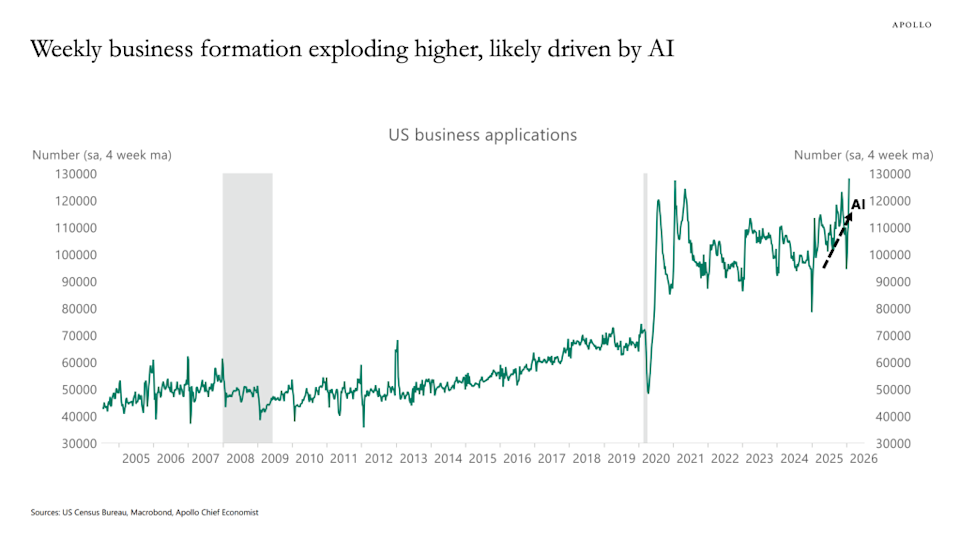
Startups are experiencing a resurgence, but this time, founders are leveraging artificial intelligence to sidestep one of their most significant initial expenses: hiring staff.
According to a recent report from the Bank of America Institute, the number of “high propensity businesses”—those the Census Bureau expects to hire employees—increased by 15.1% year-over-year in January. In contrast, applications from businesses with clear intentions to hire staff dropped by 4.4%.
This shift comes as small businesses are investing more than ever in technology, including AI. Bank of America analysts noted a 14% year-over-year increase in tech spending last month, suggesting a drive for greater productivity.
Retailers led the way in technology investments among small businesses, with spending rising over 25% last month, closely followed by manufacturers.
Small businesses, typically defined as those with fewer than 500 employees, account for roughly 45% of the American workforce. A significant slowdown in hiring among these companies could have a substantial impact on the broader job market.
After the Federal Reserve opted to keep interest rates steady this week, Chairman Jerome Powell remarked that private sector job growth had stagnated. In February, employers eliminated 92,000 jobs, leaving the unemployment rate at 4.4%.
“At this point, there’s essentially no net job creation in the private sector,” Powell said during a press conference this week.
Large corporations are also turning to AI to boost efficiency with fewer resources. For example, fintech company Block recently cut nearly half its workforce, with CEO Jack Dorsey noting that AI tools are “enabling a new way of working which fundamentally changes what it means to build and run a company.”
Some critics argue that Block’s layoffs were more about correcting pandemic-era overhiring than AI adoption, but CFO and COO Amrita Ahuja told Fortune that this was not the case.
AI has been cited as a factor in about 8% of all job cut announcements in 2026—roughly 12,304 cases—according to a study by Challenger, Gray & Christmas, an executive outplacement firm.
On the other hand, Apollo Chief Economist Torsten Slok believes that the surge in new business creation will ultimately benefit the labor market. “As these companies expand, they will generate new jobs, showing that AI is likely to enhance, not undermine, the US workforce,” he wrote in a recent note.
AI’s Impact on Engineering Teams
However, not everyone is convinced of AI’s positive impact. Andy Tang, a partner at Draper Associates, a Silicon Valley venture capital firm, observed that startups he spoke with last month had reduced their engineering teams by about one-third. This trend highlights just how transformative AI tools have become for new companies.
AI Tokens Over Headcount
Many startups are discovering that investing in AI tokens yields far greater returns than hiring additional staff, allowing them to produce three to five times more code at a fraction of the cost.
“When you crunch the numbers, you realize you need far fewer engineers,” Tang explained, noting that much of today’s knowledge work can be automated.
Looking ahead, Tang predicts that AI could empower solo founders to operate without any employees, instead deploying a network of AI agents capable of building “founderless unicorn companies.”
A New Generation of Founders and the AI Playbook
The strategy of using AI to scale quickly is catching on with a new wave of young, tech-savvy entrepreneurs.
For example, Rudy Arora and Sarthak Dhawan launched TurboAI—a tool that transforms lecture notes into flashcards and quizzes—while still in college, with less than $300 in initial funding. In just two years, the now 21-year-old founders have grown their user base to 8.5 million and generate about $1 million in monthly revenue with only 13 employees, thanks in part to AI. Despite raising $750,000 in funding, Arora said they have chosen not to spend it because the company is already profitable.
“If we had started this company two and a half years ago, we would have needed more than 100 employees,” Arora said. “AI is the only reason we can operate with just 13 people.”
Tasks that once required a product manager and several engineers can now be managed by a single technical employee using AI agents, he added.
Dhawan, Arora’s cofounder, believes startups are only beginning to realize AI’s potential to accelerate growth. He noted that during the post-2008 startup boom, launching a company often required experienced programmers and venture capital. Their experience with TurboAI demonstrates that this is no longer the case.
“We’re going to see even younger founders building companies with fewer resources than ever before,” Dhawan predicted.
This article was originally published on Fortune.com.
Disclaimer: The content of this article solely reflects the author's opinion and does not represent the platform in any capacity. This article is not intended to serve as a reference for making investment decisions.
You may also like

Whale Accumulation Spikes as XRP Gains Momentum Amidst Regulatory Optimism
4 ETFs With Yields Above 7% That Income-Focused Investors Are Discreetly Accumulating

Big Tech’s Reason for Optimism: The Connection Between the Magnificent 7 and the S&P 500 Has Been Disrupted

Trending news
MoreCrypto prices
More





