
Strategy debt, AI boom, Bitcoin collapse have analysts predicting doom: Are they right?

Key takeaways:
- Strategy’s mounting corporate debt and dividend obligations make Bitcoin vulnerable to forced reserve sales.
- Capital is migrating from crypto ETFs into AI equities, stripping Bitcoin of its near-term bullish narrative.
Bitcoin (BTC) plunged to $65,200 on Tuesday, wiping out gains from the prior three months. The correction contrasted with the strength in US stock markets, leading traders to question what drove investors away from Bitcoin. Is a retest of $60,000 underway?
Some analysts claim Strategy’s (MSTR US) weaker balance sheet position negatively impacts Bitcoin’s risk-reward profile, while others cite strong AI earnings prospects as the major catalyst.

Alex Krüger, an economist and founder of Asgard Markets, argues that Bitcoin's price action is now tied to Strategy’s corporate credit and liquidity conditions rather than to macroeconomic factors. According to Krüger, MSTR faces pressure from preferred instrument dividends after depleting its cash position, which currently supports six months of coverage.
Strategy repurchased $1.38 billion of its own convertible senior notes in May, reducing cash reserves to $900 million. Regardless of the discount applied to the $1.5 billion aggregate principal amount due in 2029, the company became more vulnerable to potential forced sales of Bitcoin reserves or stock issuance, resulting in dilution for current MSTR holders.
AI earnings growth hides a weaker macroeconomic environment
Wintermute, a cryptocurrency market maker and over-the-counter trading company, holds a different view on why Bitcoin has underperformed the US stock market lately. According to Wintermute analysts, the cryptocurrency market decoupling stems from a strong AI earnings narrative while Bitcoin lacks a fundamental story to lean on.
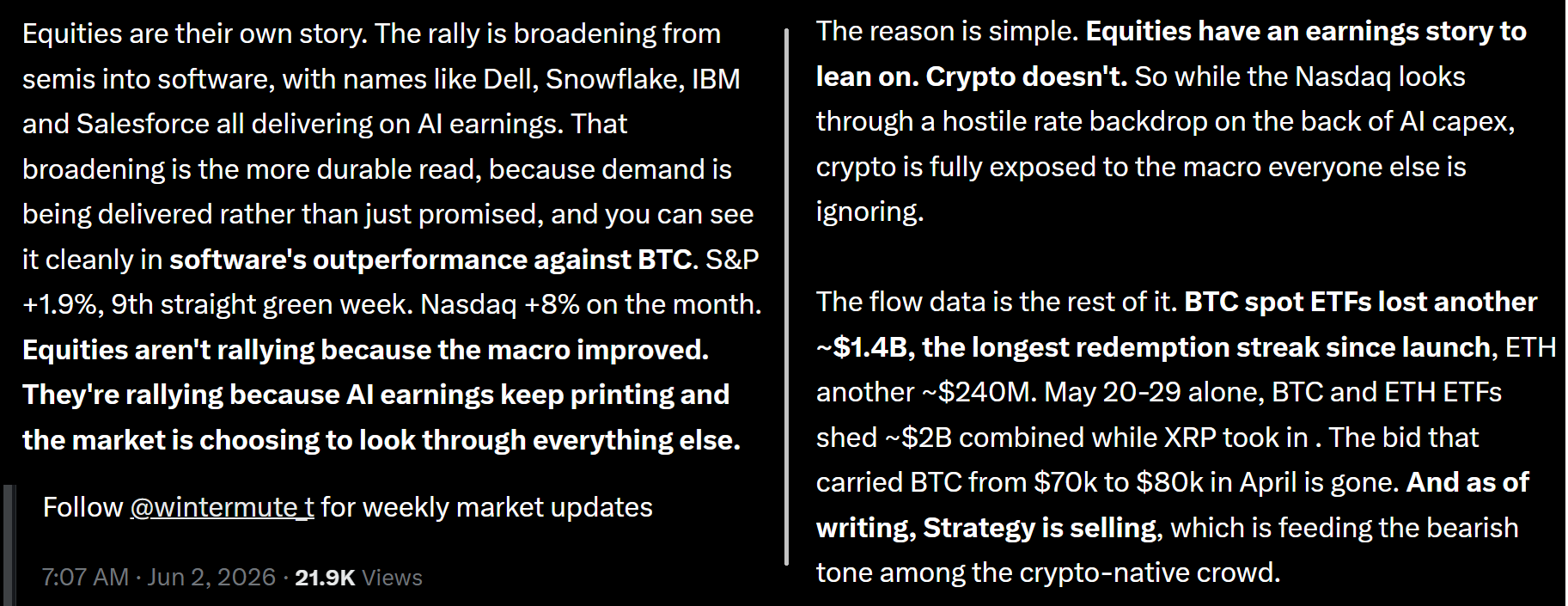
Wintermute analysts argue that the Nasdaq Index rallied as investors ignored adverse macroeconomic risks amid concrete demand for AI applications. Consequently, spot Bitcoin exchange-traded funds (ETFs) likely shifted toward AI and small-cap stocks. AI-related companies Micron (MU US) and SK Hynix (000660 KS) surpassed a $1 trillion market capitalization for the first time ever.
Wintermute suggests that the cryptocurrency market is now perceived as the most risk-sensitive asset, thus being skipped in risk-on rotations and typically behaving bearish amid expectations of tighter monetary policy in the US. Inflationary pressure caused by high energy prices keeps investors on , so Bitcoin’s typical bear market behavior could last for a while.

Stephen, co-founder of Mezzanine and founder of DeFi Dojo, argues that Strategy’s doomsday scenario is not actually worrisome, as the company could sell 1,500 BTC per month to cover its dividends. However, with the Stretch preferred stock (STRC US) trading below $100, Strategy is unable to raise equity without diluting MSTR holders.
For Stephen, multiple pathways remain for Strategy to survive a decade-long bear market, even if the Bitcoin price drops to $30,000.
Investors' worsening risk-reward perception stems from a mix of weaker macroeconomic conditions, excessive concentration in the AI sector, and fear of continued sell pressure from ETFs and large corporate holders. Ultimately, a retest of $60,000 remains possible given the lack of a constructive short-term narrative for Bitcoin.
Disclaimer: The content of this article solely reflects the author's opinion and does not represent the platform in any capacity. This article is not intended to serve as a reference for making investment decisions.
You may also like
Jamie Dimon Says He is ‘Jealous’ of Revolut, Then Attacks Crypto Reform
WLD Price Jumps 40% as World Network Narrative Gains Momentum
Crypto Market Bleeds, But ONDO Price Surges 17%: Here’s Why

ONDO Price Surges 20% as Chainlink Integration Fuels Breakout Hopes

Trending news
MoreCrypto prices
More





